Debt consolidation:
Could it help simplify your finances?

Navigate this article
Debt consolidation defined | Meet Sarah | Potential benefits | Potential downsides |
Things to consider | Really helpful loan options
Managing multiple debts can feel overwhelming, especially when repayments fall on different days, interest rates vary, and balances don’t seem to move much each month.
For some people, debt consolidation can be a way to simplify things. It usually involves combining several existing debts – such as credit cards, car loans or personal loans – into a single loan with one regular repayment.
But while debt consolidation can make repayments easier to manage, it isn’t right for everyone. Before deciding, it’s important to understand both the potential benefits and the risks.
What is debt consolidation?
Debt consolidation involves replacing multiple repayments with one loan, so you only need to make a single repayment to one lender.
In Australia, options include:
- Taking out a personal loan to pay off existing debts, or
- Refinancing your existing home loan to roll other debts into your mortgage (if you have enough equity).
Important to consider: If you're having trouble making your current payments, please contact your lender to discuss your options. If you can’t pay on time, you might miss payments which can affect your credit report and your credit score.
Meet Sarah

Sarah (a fictional Pepper Money customer) has a home loan and has built up some equity over time. Alongside her mortgage, she has:
- A credit card balance of $9,000
- A personal loan with $14,000 remaining
- A car loan with $17,000 remaining
Each debt has a different interest rate and repayment date. While Sarah has no problems meeting her monthly repayments, she’s finding it harder to track her multiple outgoings.
After speaking with her mortgage broker and reviewing her options, Sarah has decided to consolidate her personal loan, car loan and credit card into her home loan.
Before and after:
a simple numerical comparison
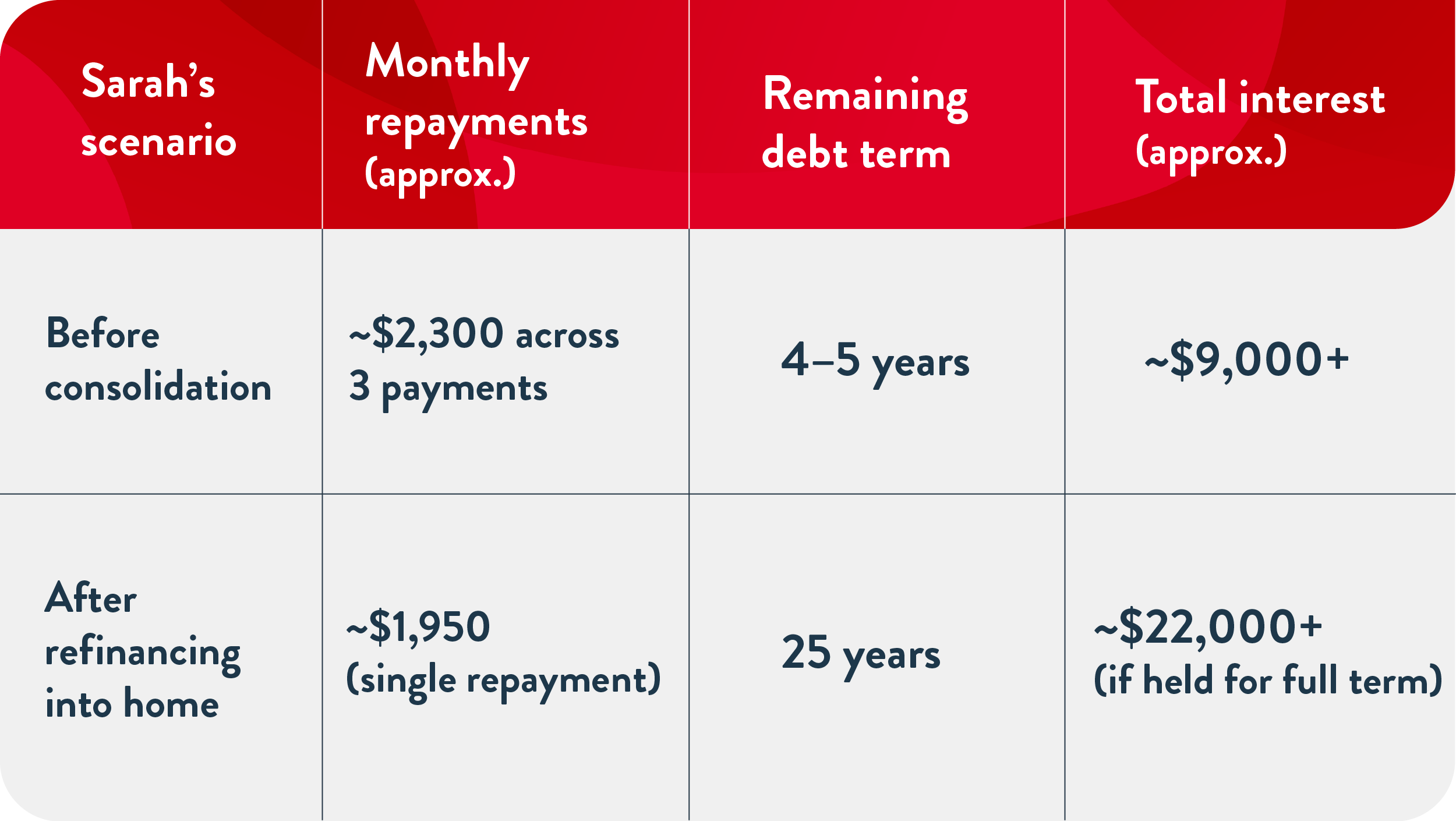
Figures below are illustrative only^. Actual repayments, interest and outcomes will depend on your loan, interest rate, fees and repayment behaviour.
What this example shows
In Sarah’s case:
- Consolidation reduced her monthly repayments.
- Having one repayment instead of three may make budgeting simpler and easier to manage.
However, there are also important trade‑offs:
- The three debts refinanced into the home loan will be repaid over a longer period, which means the total interest cost is higher if the loan runs for the full term.
- Some debts that were previously unsecured are now secured against Sarah’s home.
- The equity in the property has now reduced.
This may be an option for Sarah because she understands the long‑term impact, checks the total cost over time, and has decided that the debt consolidation suits her situation.
The potential benefits of debt consolidation
Debt consolidation may:

with one regular repayment.

by reducing multiple due dates.

Important to consider: Consolidating unsecured debts into a home loan may increase the total cost of credit and reduce the equity in your home. It’s also important to consider the total cost of refinancing, including any fees, and ensure repayments remain manageable for your circumstances.
The possible downsides to consider carefully
Debt consolidation isn’t a quick fix, and it’s important to understand the downsides before committing:


This is why it’s important to look at your situation and contact your existing lender if you’re having trouble making repayments on your current loans.
Things to think about before consolidating debt
Before choosing debt consolidation, it’s worth taking the time to:
- List all your current debts, interest rates and fees.
- Compare the total cost of your current debts with the proposed consolidated loan.
- Consider how long you’ll be repaying the debt.
- Think about whether your spending habits will change going forward.
- Speak with your existing lender to understand your options.
Debt consolidation may be an option, but it’s not suitable for everyone.
Two ways Pepper Money may be able to help
If you’re interested in discussing debt consolidation options, Pepper Money has the following options available:

1. A personal loan
A personal loan may suit people who:
- Don’t own a home or don’t have available equity
- Want a fixed loan term, fixed interest rates and structured repayments
- Are looking at a secured or unsecured loan option.

2. Refinancing your home loan
Debt consolidation with your existing Pepper home loan or refinancing from another lender may be an option for people who:
- Have sufficient equity in an existing property
- Are looking to consolidate higher‑interest debts
- Understand the long‑term implications of adding debt to their home loan
The bottom line: understand your options, then decide
Debt consolidation could help your financial situation, but it’s important to understand both the pros and cons before committing.
Taking the time to review your situation and understand your options can help you make an informed decision that supports situation and circumstances.
If you’d like to explore your options, you can talk to us about:
We’re here to help you understand what’s possible and what’s right for you.
Remember, if you’re having difficulty keeping up with repayments, it’s a good idea to contact your lender to talk through your options and understand what support may be available.

Contributor | Dianne Wassouf, Head of Customer Solutions
Dianne joined Pepper in 2012 and is now responsible for all Customer Service and Resolutions post settlement teams across Australia and Manila. Her expertise focuses on customer solutions and assistance and has equipped her with a deep understanding of client relations and service excellence.
Published by Pepper Money. Read our Editorial Policy to learn how we create and review content.
Want to find out where you stand?
Sign up to our newsletter
If you like this article, you'll love our Really helpful newsletter.
Personal information is collected, used, stored and disclosed in accordance with Pepper's Privacy Policy. I understand I can unsubscribe at any time.
Need some help with managing your loan?
Our resources are here to guide you through the process, decipher all that jargon and lend a little helping hand.




^ Assumptions: existing personal, car and credit card debts amortised over their remaining terms with indicative rates; consolidated debt assumed to be repaid over the same effective period but at a home loan interest rate of 6.50% p.a., excluding fees. Figures do not represent total interest on the full home loan balance. Actual repayments, interest and outcomes will depend on your loan, interest rate, fees and repayment behaviour.
Information provided is factual information only,and is not intended to imply any recommendation about any financial product(s) or constitute tax advice. If you require financial or tax advice you should consult a licensed financial or tax adviser. Applications are subject to credit assessment, eligibility criteria and lending limits. Terms, conditions, fees and charges apply. © Pepper Money Limited ABN 55 094 317 665; AFSL and Australian Credit Licence 286655 (“Pepper”). Pepper is the servicer of home loans provided by Pepper Finance Corporation Limited ABN 51 094 317 647. Pepper Asset Finance Pty Limited ACN 165 183 317 Australian Credit Licence 458899 is the credit provider for asset finance loans.
Pepper Money Personal Loans is a brand of Pepper Money Limited. Credit is provided by Now Finance Group Pty Ltd, Australian Credit Licence Number 425142 as agent for NF Finco 2 Pty Limited ACN 164 213 030. Personal information for Pepper Money Personal Loans is collected, used and disclosed in accordance with Pepper’s Privacy Policy & the credit provider’s Privacy Policy.